


Ionic effects on the proton transfer mechanism in aqueous solutions

초록
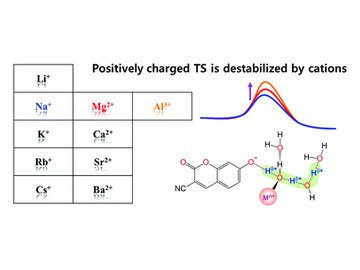
약산의 양성자 해리(PD) 반응과 수용액 내 양성자 전이(PT) 과정은 이온의 영향을 강하게 받는다. 그러나 이온이 PD와 PT 과정의 속도에 어떻게 영향을 미치는지를 기술하는 상세한 분자 수준의 그림은 여전히 없다. 여기서 우리는 시간 분해 형광 분광법과 양자화학 계산을 결합하여 금속 염화물 수용액에서 광산(photoacid)의 들뜬상태 양성자 전이(ESPT) 반응을 조사한다. 광산의 ESPT에 대한 활성화 에너지(Ea)는 양이온의 전하 밀도가 커질수록 증가한다. 이온 수화 껍질 내 광산의 국소 수소 결합(H-결합) 구조는 Ea 및 양이온의 전하 밀도 모두와 밀접하게 관련된다. 무엇보다도, H-결합으로 연결된 물 채널을 통해 비편재화된 전이 상태에서 양성자의 양전하는 양이온의 전하 밀도가 커질수록 더 불안정해져 더 높은 Ea로 이어진다. 우리의 실험 및 계산 결과는 PD와 그에 뒤따르는 PT 과정에 대한 이온 효과의 근본 메커니즘을 분자 수준에서 규명할 수 있게 한다.
Original abstract (English)
Proton dissociation (PD) reactions of weak acids and proton transfer (PT) processes in aqueous solutions are strongly influenced by ions. However, a detailed molecular picture that describes how ions affect the rates of PD and PT processes is still missing. Here, we utilize time-resolved fluorescence spectroscopy combined with quantum chemical calculations to investigate the excited-state proton transfer (ESPT) reaction of a photoacid in aqueous metal chloride solutions. The activation energy (Ea) for the ESPT of the photoacid increases with increasing charge density of cations. The local hydrogen bond (H-bond) structure of the photoacid in the ionic hydration shell is strongly related to both the Ea and the charge density of cations. Most importantly, the proton's positive charge in the transition state, which is delocalized through the H-bonded water channel, is more destabilized with an increase in the charge density of cations, leading to a higher Ea. Our experimental and computational results allow us to elucidate the underlying mechanism for the ionic effect on PD and the subsequent PT process at the molecular level.