


Chromogenic Tubular Polydiacetylenes from Topochemical Polymerization of Self-Assembled Macrocyclic Diacetylenes

초록
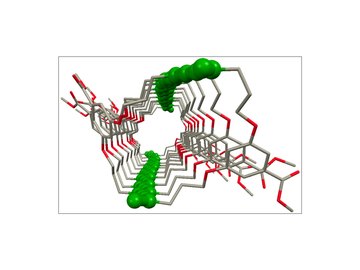
작은 유기 분자의 자기조립으로 형성된 관 모양 물질은 화학 및 재료 과학에서 큰 유용성을 지닌다. 기존의 관 모양 구조는 비공유 분자 상호작용이 그 형태적 완결성을 담당하기 때문에 안정성이 부족한 경우가 많다. 여기서 우리는 자기조립된 거대고리 다이아세틸렌(MCDA)의 위상화학적 중합을 이용하여 제조한, 공유 결합으로 연결된 발색성 유기 나노튜브의 개발을 보고한다. 서로 다른 지름을 갖는 다섯 가지 MCDA의 결정 구조를 규명하였으며, 이 중 네 가지를 자외선 유도 중합으로 관 모양 폴리다이아세틸렌(PDA)으로 전환하였다. 놀랍게도 MCDA-1은 기울기 각도 62.1°로 적층되어 자기조립하는 것으로 나타났는데, 이는 중합에 최적인 값 45°에서 크게 벗어난다. 이 관찰은 선형 다이아세틸렌(DA) 모형으로 유도한 기하학적 변수가 MCDA 시스템의 중합에 엄밀하게 적용되지 않을 수 있음을 시사한다. MCDA-1과 MCDA-3의 중합으로 얻은 청색상 PDA는 서로 다른 열변색성과 용매변색성을 가지며, 덕분에 이성질 자일렌을 포함한 방향족 용매를 색으로 구별하는 데 활용할 수 있다. 이 연구에서 얻은 관찰과 정보는 자극 응답성 강체 유기 나노튜브의 이해와 설계를 향상시킬 것이다.
Original abstract (English)
Tubular materials formed by self-assembly of small organic molecules find great utility in chemical and material science. Conventional tubular structures often lack stability because noncovalent molecular interactions are responsible for their conformational integrities. Herein we report the development of covalently linked chromogenic organic nanotubes which are prepared by using topochemical polymerization of self-assembled macrocyclic diacetylenes (MCDAs). Crystal structures of five MCDAs having different diameters were elucidated, and four of these substances were transformed to tubular polydiacetylenes (PDA) by UV-induced polymerization. Surprisingly, MCDA-1 was found to self-assemble in stacks with a tilt angle of 62.1°, which significantly deviates from the optimal value for polymerization of 45°. This observation suggests that geometric parameters derived using linear diacetylene (DA) models might not be strictly applicable to polymerization of MCDA systems. Blue-phase PDAs obtained by polymerization of MCDA-1 and MCDA-3 have different thermochromic and solvatochromic properties, which enable them to be utilized for colorimetric differentiation of aromatic solvents including isomeric xylenes. The observations made and information obtained in this study should enhance the understanding and design of stimulus-responsive rigid organic nanotubes.