


Precursor Diffusion-Controlled Scalable Synthesis of Monodisperse Iodide Perovskite Quantum Dots for Photovoltaics

Abstract
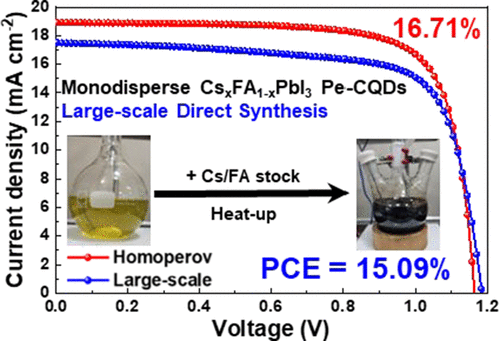
Monodisperse iodide-based perovskite colloidal quantum dots (Pe-CQDs) are attractive for photovoltaics, but scaling-up their synthesis is challenging. Because precursor conversion, nucleation, and crystal growth occur almost simultaneously during rapid ionic crystallization, large-scale production typically suffers from local concentration variations that broaden the size distribution. To address this, we report a gram-scale synthesis strategy that separates the crystallization stages through controlled precursor diffusion. Ligand-mediated regulation delays monomer formation and suppresses continuous nucleation, yielding uniform CsPbI3-Pe-CQDs without post-synthetic size selection. This diffusion-control strategy successfully extends to formamidinium (FA) incorporation, enabling the direct synthesis of composition-tunable CsxFA1–xPbI3-Pe-CQDs while bypassing conventional cation exchange. The resulting monodisperse Pe-CQDs enable the fabrication of solar cells with a power conversion efficiency of 16.7%, while maintaining a robust efficiency of over 15% even with gram-scale batches. This approach demonstrates a reliable and scalable strategy for manufacturing device-grade CQD photovoltaics without sacrificing device-relevant properties upon scale-up.