

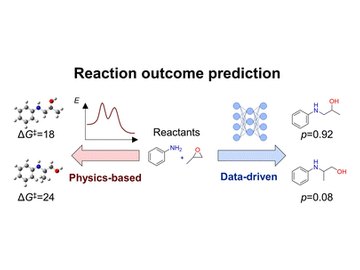
An overview of reaction outcome prediction with physics-based and data-driven methods

초록
반응 결과(reaction outcome)를 예측하는 것은 화학에서 오랜 과제이며, 그 예측 능력은 화학 반응성에 대한 우리의 이해 수준을 직접적으로 보여준다. 반응 생성물을 정확히 예측하는 일은 합성 경로 설계뿐 아니라 반응 경로와 실험을 인 실리코(in silico)로 설계하는 데에도 매우 중요하다. 이 리뷰는 반응 결과 예측에 사용되는 다양한 방법론을 살펴보며, 이들은 크게 두 갈래로 나눌 수 있다. 일부 접근법은 반응 생성물과 그 가능성을 한 번에 예측하는 반면, 다른 접근법은 후보 생성물 열거와 그에 이은 생성물 가능성 예측이라는 두 단계로 작업을 나눈다. 우리는 그래프 기반 모델과 서열 생성 모델 같은 데이터 기반 방법과, 퍼텐셜 에너지 표면 탐색과 반응성 분자동역학을 포함한 물리 기반 방법을 모두 검토한다. 또한 반응의 선택성, 위치선택성, 입체선택성, 수율의 정량적 예측에 대해서도 논의한다. 이 리뷰는 반응 결과 예측의 흐름과 진전을 정리하고, 이 분야의 향후 방향을 간략히 제시한다.
Original abstract (English)
The prediction of reaction outcomes is a longstanding challenge in chemistry, with the ability to do so serving as a direct reflection of our understanding of chemical reactivity. Accurately predicting reaction products is crucial not only for synthetic planning but also for designing reaction pathways and experiments in silico. This review explores the diverse methodologies used to predict reaction outcomes, which can be broadly divided into two main categories. Some approaches predict reaction products and their likelihoods in a single step, while others break the task into two distinct parts: candidate enumeration and the subsequent prediction of product likelihoods. We examine both data-driven methods, such as graph-based and sequence-generation models, and physics-based methods, including potential energy surface exploration and reactive molecular dynamics. In addition, we discuss quantitative predictions of reaction selectivity, regioselectivity, stereoselectivity, and yield. This review summarizes trends and advances in reaction outcome prediction and briefly outlines future directions for the field.