


Electron flow matching for generative reaction mechanism prediction




초록
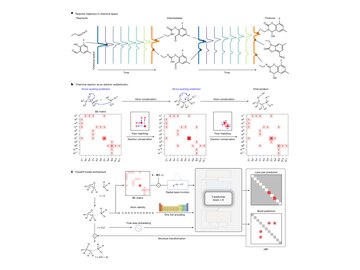
화학 반응성에 대한 우리의 이해에서 핵심은 질량 보존 법칙이며, 이는 물리적 일관성을 보장하고 반응식의 균형을 맞추며 반응 설계를 이끄는 데 근본이 된다. 그러나 반응 생성물 예측과 같은 작업을 위한 데이터 기반 계산 모델은 이 가장 기본적인 제약을 따르는 경우가 드물다. 여기서 우리는 흐름 정합(flow matching)이라는 현대적 심층 생성 프레임워크를 이용해 반응 예측 문제를 전자 재분배 문제로 재정의하고, 결합-전자(BE) 행렬 표현을 통해 질량과 전자를 모두 명시적으로 보존한다. 우리의 모델 FlowER는 정확한 질량 보존을 강제함으로써 기존 접근법에 내재된 한계를 극복하여, 환각적(hallucinatory) 오류 양상을 해소하고, 학습에 사용되지 않은 기질 골격에 대해서도 메커니즘적 반응 서열을 복원하며, 매우 데이터 효율적인 미세조정만으로 영역 밖(out-of-domain) 반응 부류에까지 효과적으로 일반화한다. 또한 FlowER는 열역학적·속도론적 실현 가능성의 후속 추정을 가능하게 하고, 반응 예측 작업에서 어느 정도의 화학적 직관을 드러낸다. 본질적으로 해석 가능한 이 프레임워크는 데이터 기반 반응 결과 예측에서 예측 정확도와 메커니즘적 이해 사이의 간극을 메우는 중요한 진전을 보여준다.
Original abstract (English)
Central to our understanding of chemical reactivity is the principle of mass conservation, which is fundamental for ensuring physical consistency, balancing equations and guiding reaction design. However, data-driven computational models for tasks such as reaction product prediction rarely abide by this most basic constraint. Here, we recast the problem of reaction prediction as a problem of electron redistribution using the modern deep generative framework of flow matching, explicitly conserving both mass and electrons through the bond-electron (BE) matrix representation. Our model, FlowER, overcomes limitations inherent in previous approaches by enforcing exact mass conservation, resolving hallucinatory failure modes, recovering mechanistic reaction sequences for unseen substrate scaffolds and generalizing effectively to out-of-domain reaction classes with extremely data-efficient fine-tuning. FlowER also enables downstream estimation of thermodynamic or kinetic feasibility and manifests a degree of chemical intuition in reaction prediction tasks. This inherently interpretable framework represents an important step in bridging the gap between predictive accuracy and mechanistic understanding in data-driven reaction outcome prediction.