


ASKCOS: Open-Source, Data-Driven Synthesis Planning



초록
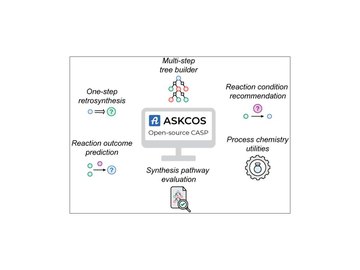
기계학습의 발전과 대규모 반응 데이터셋의 가용성은 지난 10년간 컴퓨터 보조 합성 계획(CASP)을 위한 데이터 기반 모델의 개발을 가속하였다. 이 단평(Account)에서 우리는 2016년부터 개발해 온 오픈소스 합성 계획 소프트웨어 모음인 ASKCOS의 최신 버전에 통합된 다양한 데이터 기반 방법과 모델을 소개한다. 이러한 지속적인 노력은 연구와 개발 사이의 간극을 메우고, 누구나 무료로 쓸 수 있는 실용적 도구를 통해 연구 성과를 제공하는 것의 중요성에서 비롯되었다. ASKCOS는 역합성 계획 모듈, 반응 조건 예측과 반응 생성물 예측이라는 상호 보완적 기능 모듈, 그리고 합성 계획에서 다양한 역할을 하는 여러 보조 모듈과 유틸리티를 통합한다. 역합성 계획을 위해 우리는 사용자 주도 탐색을 위한 대화형 경로 계획기(IPP)와, 잘 알려진 두 가지 트리 탐색 알고리즘인 몬테카를로 트리 탐색(MCTS) 및 Retro*를 이용한 자동 계획용 트리 빌더를 개발하였다. 주형 기반(template-based)과 주형 비의존(template-free) 전략을 아우르는 네 가지 단일 단계 역합성 모델이 역합성 예측의 기반을 이루며, 이들을 동시에 사용해 각자의 장점을 결합하고 다양한 제안을 내놓을 수 있다. 제안된 반응 단계의 실현 가능성을 평가하고 전체 경로를 평가하는 전략은 반응 조건 추천, 경로 점수화 및 군집화, 그리고 주생성물·불순물·자리 선택성·위치선택성을 포함한 반응 결과 예측이라는 하위 과제에서 우리가 이룬 여러 선구적 노력 위에 구축되었다. 또한 우리는 용해도 예측과 양자역학적 기술자(descriptor) 예측에 관한 과거와 현재의 연구를 바탕으로 ASKCOS의 보조 기능도 개발하였는데, 이는 제안된 반응 용매의 적합성이나 원하는 변환의 가상 선택성에 대해 더 많은 통찰을 제공할 수 있다. 우리는 이들 각 기능에 대해 합성 계획의 맥락에서의 의의를 짚고, 그것이 우리 연구뿐 아니라 이 분야의 다른 최근 발전 위에 어떻게 구축되었는지를 포괄적으로 개관한다. ASKCOS는 전문가의 의사결정과 경로 구상을 보완함으로써 수백 명의 의약·합성·공정 화학자의 일상 업무를 도와 왔다. 우리는 CASP 도구가 현대 화학 연구의 중요한 일부이며 갈수록 더 큰 유용성과 접근성을 제공한다고 믿는다.
Original abstract (English)
The advancement of machine learning and the availability of large-scale reaction datasets have accelerated the development of data-driven models for computer-aided synthesis planning (CASP) in the past decade. In this Account, we describe the range of data-driven methods and models that have been incorporated into the newest version of ASKCOS, an open-source software suite for synthesis planning that we have been developing since 2016. This ongoing effort has been driven by the importance of bridging the gap between research and development, making research advances available through a freely available practical tool. ASKCOS integrates modules for retrosynthetic planning, modules for the complementary capabilities of condition prediction and reaction product prediction, and several supplementary modules and utilities with various roles in synthesis planning. For retrosynthetic planning, we have developed an Interactive Path Planner (IPP) for user-guided search as well as a Tree Builder for automatic planning with two well-known tree search algorithms, Monte Carlo Tree Search (MCTS) and Retro*. Four one-step retrosynthesis models covering template-based and template-free strategies form the basis of retrosynthetic predictions and can be used simultaneously to combine their advantages and propose diverse suggestions. Strategies for assessing the feasibility of proposed reaction steps and evaluating the full pathways are built on top of several pioneering efforts that we have made in the subtasks of reaction condition recommendation, pathway scoring and clustering, and the prediction of reaction outcomes including the major product, impurities, site selectivity, and regioselectivity. In addition, we have also developed auxiliary capabilities in ASKCOS based on our past and ongoing work for solubility prediction and quantum mechanical descriptor prediction, which can provide more insight into the suitability of proposed reaction solvents or the hypothetical selectivity of desired transformations. For each of these capabilities, we highlight its relevance in the context of synthesis planning and present a comprehensive overview of how it is built on top of not only our work but also other recent advancements in the field. ASKCOS has assisted hundreds of medicinal, synthetic, and process chemists in their day-to-day tasks by complementing expert decision making and route ideation. It is our belief that CASP tools are an important part of modern chemistry research and offer ever-increasing utility and accessibility.