


Generative deep learning-based efficient design of organic molecules with tailored properties

초록
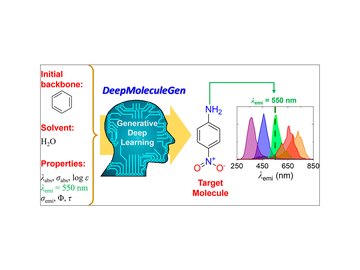
원하는 물성을 갖도록 분자를 설계하는 혁신적 접근법은 여러 연구 분야에서 요구된다. 딥러닝 방법은 분자의 구조-물성 관계를 활용하여 새로운 물질의 발견을 가속할 수 있다. 이 연구에서 우리는 71,424개의 분자/용매 쌍을 포함하는 대규모 실험 데이터베이스(DBexp)로 학습되어 다양한 용매에서 목표 물성을 갖는 분자를 설계할 수 있는 생성형 딥러닝(Gen-DL) 모델을 성공적으로 개발하였다. Gen-DL 모델은 전자 흡수/방출 피크 위치와 대역폭, 흡광 계수, 광발광(PL) 양자 수율, PL 수명과 같은 지정된 광학 물성을 갖는 분자를 생성할 수 있다. Gen-DL 모델은 목표 광학 물성을 갖는 분자를 생성할 때 공액 효과, 스토크스 이동, 용매 효과라는 핵심 설계 원리를 활용하는 것으로 나타났다. 또한 Gen-DL 모델은 실제 응용을 위해 개발된 실용적으로 유용한 분자를 생성함을 보였다. 따라서 Gen-DL 모델은 유기 태양전지(OPV), 유기 발광 다이오드(OLED), 유기 광다이오드(OPD), 바이오이미징 염료 등 다양한 연구 분야에서 원하는 물성을 갖는 새로운 분자를 발견하고 설계하는 유망한 도구가 될 수 있다.
Original abstract (English)
Innovative approaches to design molecules with tailored properties are required in various research areas. Deep learning methods can accelerate the discovery of new materials by leveraging molecular structure-property relationships. In this study, we successfully developed a generative deep learning (Gen-DL) model that was trained on a large experimental database (DBexp) including 71,424 molecule/solvent pairs and was able to design molecules with target properties in various solvents. The Gen-DL model can generate molecules with specified optical properties, such as electronic absorption/emission peak position and bandwidth, extinction coefficient, photoluminescence (PL) quantum yield, and PL lifetime. The Gen-DL model was shown to leverage the essential design principles of conjugation effects, Stokes shifts, and solvent effects when it generated molecules with target optical properties. Additionally, the Gen-DL model was demonstrated to generate practically useful molecules developed for real-world applications. Accordingly, the Gen-DL model can be a promising tool for the discovery and design of novel molecules with tailored properties in various research areas, such as organic photovoltaics (OPVs), organic light-emitting diodes (OLEDs), organic photodiodes (OPDs), bioimaging dyes, and so on.