


Universal surface tailoring of perovskite nanocrystals via organic pseudohalide ligands applicable to green and blue light-emitting diodes

초록
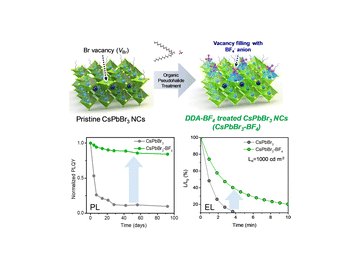
페로브스카이트 나노결정(PeNC)의 표면 결함을 적절히 관리하면 거의 100%에 가까운 광발광 양자 수율과 고성능 발광 다이오드(LED)를 구현할 수 있다. 그러나 대부분의 PeNC는 여전히 불완전한 표면 패시베이션 문제를 안고 있어 이상적이지 못한 효율을 보인다. 여기서 우리는 유기 유사할로젠(pseudohalide) 리간드인 다이도데실다이메틸암모늄 테트라플루오로보레이트(DDA-BF4)를 이용해 CsPbBr3 나노결정의 표면을 간단히 처리하는 방법을 고안하였다. 그 결과 DDA 양이온과 BF4 음이온이 CsPbBr3 나노결정 표면에 동시에 배위하여 광학 특성과 콜로이드 안정성을 크게 향상시키는 것으로 나타났다. 이 패시베이션을 적용한 표면 처리 CsPbBr3 나노결정을 녹색 LED에 적용한 결과, 처리하지 않은 PeNC를 사용한 LED보다 외부 양자 효율이 현저히 높았고 516 nm 파장에서 안정적인 전계발광(EL)을 보였다. 또한 이 방법을 CsPbBr3-xClx 나노결정 기반의 하늘색 LED(EL 484 nm)에 적용했을 때에도 유사한 소자 성능 향상이 관찰되었다. 우리는 유기 유사할로젠 처리가 녹색 및 청색 PeNC 기반 LED에 두루 적용할 수 있는 보편적 방법론을 제공하며, 미래의 디스플레이와 조명 기술을 위한 유망한 플랫폼이 될 것이라 본다.
Original abstract (English)
Proper management of surface defects in perovskite nanocrystals (PeNCs) has resulted in near-unity photoluminescence quantum yield and the development of high-performance light-emitting diodes (LEDs). However, most PeNCs still suffer from incomplete surface passivation, which results in non-ideal efficiencies. Herein, we devise a simple surface tailoring of CsPbBr3 NCs with organic pseudohalide ligands, didodecyldimethylammonium tetrafluoroborate (DDA-BF4). Results suggest that the DDA cation and BF4 anion simultaneously coordinated on the CsPbBr3 NC surfaces, thereby dramatically improving optical properties and colloidal stability. With this passivation, surface-tailored CsPbBr3 NCs were applied to green LEDs, which showed significantly higher external quantum efficiencies than LEDs with untreated PeNCs and stable electroluminescence (EL) at a wavelength of 516 nm. Also, when this method was applied to sky-blue LEDs based on CsPbBr3-xClx NCs (EL at 484 nm), similar improvement in device performance was observed. We believe that organic pseudohalide treatment provides a universal methodology that can be applicable to green and blue PeNC-based LEDs, providing a promising platform for future displays and lighting technologies.