

Reliable experimental method for determination of photoacidity revealed by quantum chemical calculations

초록
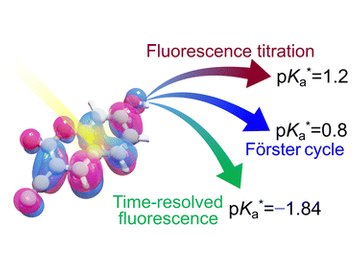
광산(photoacid)은 전자적으로 들뜬 상태가 되면 산도가 크게 달라지는 방향족 산이다. 광산도를 결정하는 데에는 형광 적정, 푀르스터 회로(Förster cycle), 시간 분해 실험의 세 가지 실험 방법이 널리 사용되어 왔다. 그러나 이들 방법으로 측정한 광산도 값은 서로 일치하지 않는다. 이 연구에서는 실험으로 결정한 값의 신뢰성을 이론적으로 평가하였다. 구체적으로 밀도범함수이론(DFT)과 시간의존 DFT 계산을 이용하여 광산도 값과 직접 관련된 산 해리 반응의 깁스 자유 에너지 변화를 구하였다. 간단하다는 이유로 광산도 측정에 자주 쓰이는 푀르스터 회로는 전이 에너지를 어떻게 정의하느냐에 따라 결과가 달라졌다. 이에 우리는 광산의 산성 화학종과 염기성 화학종의 흡수 및 방출 스펙트럼에서 추출한 여섯 가지 경험적 매개변수를 검토하여 푀르스터 회로의 전이 에너지를 적절히 정의하고자 하였다. 그 결과, 광학적 밴드갭을 전이 에너지로 사용했을 때 얻은 값이 양자화학 계산 결과와 가장 잘 일치함을 확인하였다.
Original abstract (English)
Photoacids are aromatic acids that exhibit significantly different acidities when they are electronically excited. Three experimental methods have been extensively used to determine the photoacidity: fluorescence titration, the Förster cycle, and time-resolved experiments. However, the photoacidities determined by these experimental methods are not consistent. In this work, we used a theoretical method to evaluate the reliability of experimentally determined values. In particular, density functional theory (DFT) and time-dependent DFT calculations were used to obtain the changes in Gibbs free energy for acid dissociation reactions which are directly related to values. The Förster cycle, which is frequently used to experimentally determine the photoacidity due to its simplicity, yielded inconsistent results depending on how the transition energy was defined. We evaluated six empirical parameters extracted from the absorption and emission spectra of acidic and basic species of photoacids to adequately define the transition energy in the Förster cycle. And we found that the values obtained using the optical bandgap as the transition energy in the Förster cycle were in the best agreement with the results of quantum chemical calculations.