


Deep learning for development of organic optoelectronic devices: Efficient prescreening of hosts and emitters in deep-blue fluorescent OLEDs

초록
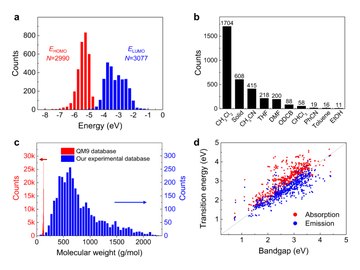
광전자 소자에서 핵심 인자인 최고점유분자궤도(HOMO)와 최저비점유분자궤도(LUMO) 에너지는 새로 설계된 물질에 대해 정확하게 추정되어야 한다. 여기서 우리는 용매 또는 고체 상태의 유기 분자 3026종의 HOMO와 LUMO 에너지를 담은 실험 데이터베이스로 학습되어, 분자의 HOMO와 LUMO 에너지를 평균 절대 오차 0.058 eV로 예측할 수 있는 딥러닝(DL) 모델을 개발하였다. 또한 우리는 이 DL 모델이 유기 발광 다이오드(OLED)를 위한 최적의 호스트와 발광체(emitter) 분자를 가상 스크리닝하는 데 효과적으로 사용됨을 보였다. DL 예측으로 선택한 발광체와 호스트 분자로 제작한 짙은 청색(deep-blue) 형광 OLED는 412 nm에서 좁은 방출(대역폭 = 36 nm)과 6.58%의 외부 양자 효율을 나타냈다. 우리의 DL 보조 가상 스크리닝 방법은 광전자공학의 구성 소재 개발에 더욱 폭넓게 적용될 수 있다.
Original abstract (English)
The highest occupied molecular orbital (HOMO) and lowest unoccupied molecular orbital (LUMO) energies, which are key factors in optoelectronic devices, must be accurately estimated for newly designed materials. Here, we developed a deep learning (DL) model that was trained with an experimental database containing the HOMO and LUMO energies of 3026 organic molecules in solvents or solids and was capable of predicting the HOMO and LUMO energies of molecules with the mean absolute errors of 0.058 eV. Additionally, we demonstrated that our DL model was efficiently used to virtually screen optimal host and emitter molecules for organic light-emitting diodes (OLEDs). Deep-blue fluorescent OLEDs, which were fabricated with emitter and host molecules selected via DL prediction, exhibited narrow emission (bandwidth = 36 nm) at 412 nm and an external quantum efficiency of 6.58%. Our DL-assisted virtual screening method can be further applied to the development of component materials in optoelectronics.