

Pyridine-NBD: A homocysteine-selective fluorescent probe for glioblastoma (GBM) diagnosis based on a blood test

초록
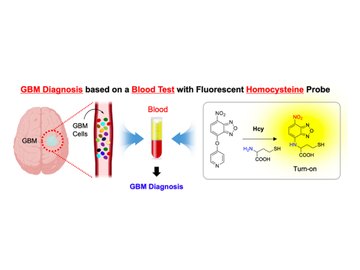
정밀한 체외(in vitro) 진단을 위해서는 진단 시약의 높은 선택성과 민감도가 요구된다. 이러한 점에서 형광 진단 탐침은 다양한 임상 분야에서 주목받아 왔다. 여기서 우리는 피리딘-싸이올 배위와 아민 첨가 반응에 기반한 맞춤형 형광 호모시스테인 탐침(NPO-Pyr)을 공개하였다. 지금까지 호모시스테인(Hcy)은 여러 질환의 우수한 생체표지자로 인식되어 왔으나, 시스테인(Cys)과 구조가 유사하여 Hcy 검출에는 여전히 한계가 있었다. 이 연구에서 우리는 NBD 형광단의 골격에 4-하이드록시피리딘 부위를 도입하여 Hcy를 모니터링하는 새로운 형광 진단 탐침을 개발하였다. 도입된 피리딘 부위는 Hcy의 싸이올기와 배위한 뒤 아민 첨가 반응(12 kJ/mol)을 일으킬 수 있다. 이러한 원리에 따라 NPO-Pyr는 Hcy에 반응하여 높은 선택성과 민감도(검출한계 0.084 ppm), 빠른 응답 시간(5분 미만)으로 신호가 켜지는(turn-on) 특성을 나타냈다. 나아가 NPO-Pyr는 혈장 내 Hcy를 감지함으로써 교모세포종(GBM)의 형성을 초기 단계에서 예측할 수 있었다(건강군 대비 ****P < 0.0001). 우리의 연구 결과는 기초 과학에서 임상 응용에 이르는 다양한 분야에서 중요한 의의를 가지며, 우리는 NPO-Pyr가 더 간단한 체외 시약으로서 현재의 복잡한 GBM 진단 과정을 완전히 대체할 잠재력이 있다고 확신한다.
Original abstract (English)
The precise in vitro diagnosis requires high selectivity and sensitivity for a diagnostic agent. In this respect, fluorescent diagnostic probes have attracted attention in various clinical fields. Herein, we disclosed a tailor-made fluorescent homocysteine probe (NPO-Pyr) based on pyridine-thiol coordination and amine-addition. To date, homocysteine (Hcy) has been recognized as an excellent biomarker for various diseases, but there still remain some limitations in detecting Hcy due to its structural similarity to Cys. In this study, we developed a new fluorescent diagnostic probe for monitoring Hcy by incorporating a 4-hydroxy-pyridine moiety into the skeleton of the NBD fluorophore. The incorporated pyridine moiety could coordinate with the thiol group at Hcy, followed by the amine-addition reaction (12 kJ/mol). Based on this rationale, NPO-Pyr responded to Hcy and exhibited turn-on properties with high selectivity and sensitivity (LOD: 0.084 ppm) and a fast response time (<5 min). Furthermore, NPO-Pyr could predict the formation of glioblastoma (GBM) at an early stage through sensing Hcy in blood plasma (vs. healthy group, ****P < 0.0001). Our findings have significant importance across various fields from basic science to clinical translation, and we strongly believe that NPO-Pyr has the potential to fully replace the current complex GBM diagnostic process as a simpler in vitro agent.