


Locoregional Recurrence Prediction Using a Deep Neural Network of Radiological and Radiotherapy Images

초록
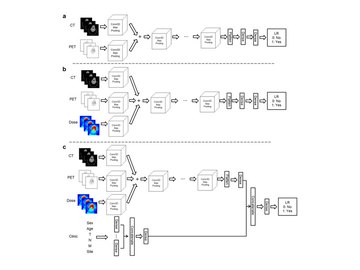
방사선 치료(RT)는 두경부 편평세포암(HNSCC)에 대한 중요하고 완치 가능성이 있는 치료법이다. RT 후 HNSCC의 국소영역 재발(LR)은 원발 부위와 병기에 따라 15%에서 50%에 이른다. 게다가 LR이 발생한 환자의 5년 생존율은 낮다. LR이 발생할 수 있는 고위험 환자를 분류하기 위해서는 LR을 예측하는 딥러닝 모델을 구축할 필요가 있다. 이 연구에서는 RT를 받은 HNSCC 환자 157명을 분석하였다. FDG-PET/CT/선량 정보를 담은 미국 국립암연구소(NCI)의 다기관 TCIA 데이터셋을 바탕으로, 시간이 많이 드는 분할(segmentation)이나 특징 추출 없이 LR을 예측하는 3차원 딥러닝 모델을 제안하였다. 우리 모델은 평균 곡선하면적(AUC) 0.856을 달성하였다. 모델에 임상 인자를 추가하자 AUC가 평균 0.892로, 최고 0.974까지 향상되었다. 이 3차원 딥러닝 모델은 시간이 많이 드는 종양 분할 없이도 HNSCC 환자의 LR 위험을 개인별로 정량화할 수 있었다.
Original abstract (English)
Radiation therapy (RT) is an important and potentially curative modality for head and neck squamous cell carcinoma (HNSCC). Locoregional recurrence (LR) of HNSCC after RT ranges from 15% to 50% depending on the primary site and stage. In addition, the 5-year survival rate of patients with LR is low. To classify high-risk patients who might develop LR, a deep learning model for predicting LR needs to be established. In this work, 157 patients with HNSCC who underwent RT were analyzed. Based on the National Cancer Institute's multi-institutional TCIA data set containing FDG-PET/CT/dose, a 3D deep learning model was proposed to predict LR without time-consuming segmentation or feature extraction. Our model achieved an averaged area under the curve (AUC) of 0.856. Adding clinical factors into the model improved the AUC to an average of 0.892, with the highest AUC of up to 0.974. The 3D deep learning model could perform individualized risk quantification of LR in patients with HNSCC without time-consuming tumor segmentation.