


Rational Molecular Design of Azaacene-based Narrowband Green-emitting Fluorophores: Modulation of Spectral Bandwidth and Vibronic Transitions

초록
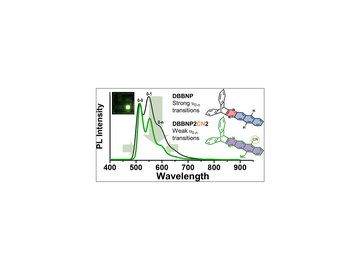
여러 위치에 나이트릴 치환기를 도입하여 테트라아자아센(tetra-azaacene) 코어 기반의 녹색 발광 형광체 시리즈를 합성하였다. 이들의 분자 구조-광학 물성 관계[즉, 광발광(PL) 및 전계발광(EL) 스펙트럼에서의 진동전자(vibronic) 전이]를 조사하여, ν0-n(n = 1, 2, 3...) 전이를 억제하고 진동전자 피크 ν0-0를 강화함으로써 날카로운 방출을 얻고자 하였다. 헥세인 중 DBBNP, DBBNP2CN1, DBBNP2CN2의 PL 스펙트럼에서 ν0-1과 ν0-0 진동전자 전이의 세기 비(I0-1/I0-0)는 각각 1.13, 0.80, 0.67이었다. 이론 계산에 따르면 DBBNP2CN2의 8번과 13번 위치에 도입된 CN 치환은 균일한 전하 분포를 유도하고 전자 전이에 결합된 진동 정규 모드의 황-리스 인자(HRF)를 감소시킨다. DBBNP2CN2로 제작한 유기 발광 다이오드(OLED)는 DBBNP나 DBBNP2CN1을 사용한 소자보다 좁은 대역폭(50 nm)으로 518 nm에서 더 좁은 녹색 EL 방출을 보였다. 분자 구조와 치환기 위치를 세심하게 조절함으로써 진동의 HRF를 줄여 I0-1/I0-0가 감소된 좁은 방출 대역폭을 달성할 수 있었으며, 이는 넓은 색역(wide-gamut)의 OLED 디스플레이를 위한 색 순도 향상을 목표로 좁은 대역의 유기 형광체를 개발하는 설계 전략을 제시한다.
Original abstract (English)
A series of green-emitting fluorophores based on a tetra-azaacene core is synthesized by introducing nitrile substituents at different positions. Their molecular structure-optical property relationship [i.e., vibronic transitions in photoluminescence (PL) and electroluminescence (EL) spectra] is investigated to obtain a sharp emission where the vibronic peak ν0-0 should be intensified by suppressing ν0-n (n = 1, 2, 3...) transitions. The intensity ratios (I0-1/I0-0) of the ν0-1 and ν0-0 vibronic transitions in the PL spectra of DBBNP, DBBNP2CN1, and DBBNP2CN2 in hexane are 1.13, 0.80, and 0.67, respectively. Theoretical calculations explain that the CN substitution at positions 8 and 13 in DBBNP2CN2 induces a uniform charge distribution and reduces the Huang-Rhys factors (HRFs) of the vibrational normal modes coupled to the electronic transition. The organic light-emitting diode (OLED) fabricated with DBBNP2CN2 shows a narrower green EL emission at 518 nm with a smaller bandwidth (50 nm) than those of devices adopting DBBNP or DBBNP2CN1. The careful modification of the molecular structures and positions of substituents enables us to reduce the HRFs of vibrations to achieve a narrow emission bandwidth with decreased I0-1/I0-0, which suggests a design strategy to develop narrowband organic fluorophores to improve the color purity for wide-gamut OLED displays.