


Deep Learning Optical Spectroscopy Based on Experimental Database: Potential Applications to Molecular Design

초록
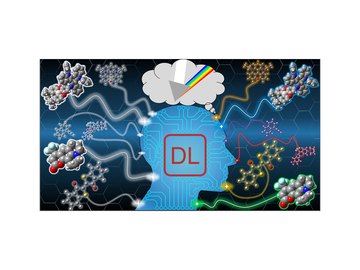
유기 화합물의 광학적·광물리적 물성을 정확하고 신뢰성 있게 예측하는 것은 다양한 연구 분야에서 중요하다. 여기서 우리는 딥러닝(DL) 모델과 실험 데이터베이스를 이용한 딥러닝 광분광법을 개발하여 유기 화합물의 일곱 가지 광학적·광물리적 물성, 즉 흡수 피크 위치와 대역폭, 흡광 계수, 방출 피크 위치와 대역폭, 광발광 양자 수율(PLQY), 방출 수명을 예측하였다. 우리의 DL 모델은 국소 환경이 유기 화합물의 광학적·광물리적 물성에 미치는 영향을 반영하기 위해 발색단-용매 상호작용을 포함하였으며, 30,094개의 발색단/용매 조합으로 이루어진 실험 데이터베이스로 학습되었다. 우리의 딥러닝 광분광법은 용액, 기체상, 박막, 분말 상태의 유기 화합물에 대해 앞서 언급한 물성들을, 흡수 및 방출 피크 위치에 대해 각각 26.6 nm와 28.0 nm, 흡수 및 방출 대역폭에 대해 각각 603 cm-1과 532 cm-1, 흡광 계수·PLQY·방출 수명의 로그 값에 대해 각각 0.209, 0.371, 0.262의 평균제곱근오차로 신뢰성 있게 그리고 빠르게 예측할 수 있게 하였다. 끝으로 우리는 원하는 광학적·광물리적 물성을 갖는 청색 발광체를 딥러닝 광분광법으로 효율적으로 가상 스크리닝하고 개발할 수 있음을 보였다. 딥러닝 광분광법은 다양한 연구 분야에서 발색단과 형광체를 개발하는 데 효율적으로 활용될 수 있다.
Original abstract (English)
Accurate and reliable prediction of the optical and photophysical properties of organic compounds is important in various research fields. Here, we developed deep learning (DL) optical spectroscopy using a DL model and experimental database to predict seven optical and photophysical properties of organic compounds, namely, the absorption peak position and bandwidth, extinction coefficient, emission peak position and bandwidth, photoluminescence quantum yield (PLQY), and emission lifetime. Our DL model included the chromophore-solvent interaction to account for the effect of local environments on the optical and photophysical properties of organic compounds and was trained using an experimental database of 30,094 chromophore/solvent combinations. Our DL optical spectroscopy made it possible to reliably and quickly predict the aforementioned properties of organic compounds in solution, gas phase, film, and powder with the root mean squared errors of 26.6 and 28.0 nm for absorption and emission peak positions, 603 and 532 cm-1 for absorption and emission bandwidths, and 0.209, 0.371, and 0.262 for the logarithm of the extinction coefficient, PLQY, and emission lifetime, respectively. Finally, we demonstrated how a blue emitter with desired optical and photophysical properties could be efficiently virtually screened and developed by DL optical spectroscopy. DL optical spectroscopy can be efficiently used for developing chromophores and fluorophores in various research areas.