


Green-, Red-, and Near-Infrared-Emitting Polymer Dot Probes for Simultaneous Multicolor Cell Imaging with a Single Excitation Wavelength

초록
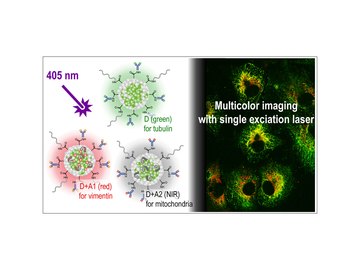
우리는 형광 공명 에너지 전이(FRET)에 기반하여 새로 합성한 녹색·적색·근적외선(NIR) 발광 고분자 점(Pdot) 탐침을 보고한다. 형광 Pdot(약 60 nm)은 녹색 발광 공액 고분자(PPDT-P, 주개)만으로, 또는 주개를 적색이나 NIR 발광 형광단(T-DCS 또는 ITIC, 받개)과 혼합하여 제조하였으며, 이때 광학적으로 비활성인 기질 고분자[폴리(스타이렌-co-말레산 무수물)]를 함께 섞어 형광단을 희석함으로써 응집에 의한 소광을 최소화하고, 능동 표적화를 위한 항체와의 추가 생체접합을 위해 표면을 기능화하였다. 광발광(PL) 양자 효율 약 30%의 강한 녹색 발광 PPDT-P Pdot을 제조하였으며, FRET를 매개로 한 적색 및 NIR PL은 효율적인 에너지 전이(FRET 효율 80-98%)와 안테나 효과를 통해, Pdot 내 형광단의 직접 여기로 얻은 신호 대비 5.3-8.5배(높은 FRET 비 약 9) 증대되었다. 세 종류의 Pdot/항체 접합체를 COS-7 세포에 동시에 면역염색하여(교차 반응성은 최소) 번거로운 순차적 면역염색 과정을 한 단계로 줄였다. 끝으로, 복잡하거나 비싼 다중 여기 장치 없이 405 nm 단일 파장에서 모든 탐침을 동시에 여기함으로써 스펙트럼 누출이 거의 없는 고대비 3색 세포 이미지를 얻었다.
Original abstract (English)
We report newly synthesized fluorescence resonance energy transfer (FRET)-based green-, red-, and near-infrared (NIR)-emitting polymer dot (Pdot) probes. Fluorescent Pdots (~60 nm) were prepared with a green-emissive conjugated polymer (PPDT-P, donor) alone or by mixing the donor with a red- or NIR-emitting fluorophore (T-DCS or ITIC, acceptor), where an optically inert matrix polymer [poly(styrene-co-maleic anhydride)] was mixed together to minimize the aggregation-caused quenching by diluting the fluorophores and to provide surface functionalization for further bioconjugation with antibodies for active targeting. Highly fluorescent green-emissive PPDT-P Pdots were prepared with a photoluminescence (PL) quantum efficiency of ~30%, and the FRET-mediated red and NIR PL was intensified by 5.3-8.5 times (with high FRET ratios of ~9) via the efficient energy transfer (FRET efficiency of 80-98%) and antenna effect, compared with the signals obtained via direct excitation of the fluorophores in Pdots. All three types of Pdot/antibody conjugates were simultaneously immunostained to COS-7 cells (showing minimal cross-reactivity), reducing the tedious sequential immunostaining process to a single step. Finally, we obtained high-contrast three-color cell images with little spectral leakthrough by exciting all the probes simultaneously at a single wavelength at 405 nm without the need for a complicated or expensive multiple-excitation setup.