


Origin of the Reversible Thermochromic Properties of Polydiacetylenes Revealed by Ultrafast Spectroscopy

초록
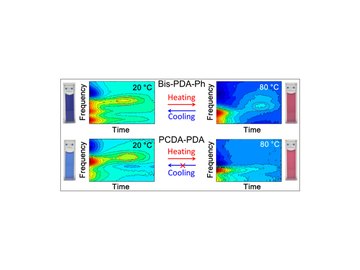
열변색성을 갖는 폴리다이아세틸렌(PDA)은 외부 온도가 변하면 색 전이를 겪는다. 이 능력은 이들 물질을 온도 센서로 활용할 수 있게 하는 잠재력을 지닌다. PDA의 이러한 열변색성은 온도 의존적 광학 물성에서 비롯된다. 이 연구에서 우리는 가역적 열변색성을 보이는 Bis-PDA-Ph와 비가역적 열변색성을 보이는 PCDA-PDA의 온도 의존적 광학 물성을 자외선-가시광선 흡수 및 펨토초 과도 흡수 분광법으로 조사하였다. 우리의 결과는 물질이 가역적 열변색성을 보이는 경우 PDA의 전자 이완이 중간 상태를 거쳐 일어나는 반면, 비가역적 열변색성이 관찰될 때에는 들뜬 PDA가 바닥상태로 직접 되돌아감을 보여준다. 따라서 PDA의 전자 이완에서 이 중간 상태의 존재는 열변색성을 결정하는 데 중요한 역할을 한다. 이 결과는 PDA의 열변색성을 이해하고 전략적으로 조절하는 데 모두 매우 중요하다.
Original abstract (English)
Polydiacetylenes (PDAs) with thermochromic properties undergo colorimetric transitions when the external temperature is varied. This capability has the potential to enable these materials to be used as temperature sensors. These thermochromic properties of PDAs stem from their temperature-dependent optical properties. In this work, we studied the temperature-dependent optical properties of Bis-PDA-Ph, which exhibits reversible thermochromic properties, and PCDA-PDA, which exhibits irreversible thermochromic properties, by UV-visible absorption and femtosecond transient absorption spectroscopy. Our results indicate that the electronic relaxation of PDAs occurs via an intermediate state in cases where the material exhibits reversible thermochromic properties, whereas the excited PDAs relax directly back to the ground state when irreversible thermochromic properties are observed. The existence of this intermediate state in the electronic relaxation of PDAs thus plays an important role in determining their thermochromic properties. These results are very important for both understanding and strategically modulating the thermochromic properties of PDAs.