


Penta-fluorophenol: A Smiles rearrangement-inspired cysteine-selective fluorescent probe for imaging of human glioblastoma

초록
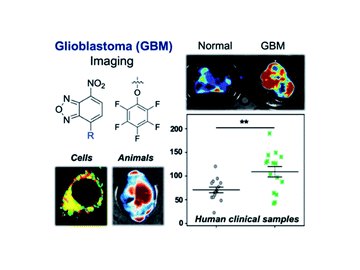
교모세포종(GBM) 환자의 생존에 가장 중요한 두 가지 요소는 정밀 진단과 치료 경과의 추적이다. 현재 다양하고 정교하며 특이적인 진단 절차가 사용되고 있지만, 간단한 진단 방법은 상대적으로 적다. 이 연구는 GBM의 새로운 생체표지자로 인식되는 시스테인(Cys) 수치를 사람 유래 세포와 현장의 사람 임상 생검 시료에서 측정할 수 있는, 신호가 켜지는(turn-on) 형광 반응 기반의 감지 탐침을 소개한다. 이 탐침의 Cys 개시 화학 반응은 높은 선택성, 높은 민감도, 빠른 응답 시간, 이광자 여기 경로를 갖는 뚜렷한 형광 반응을 일으켜 마우스 모델과 사람 조직 시료 모두에서 GBM의 이미징을 가능하게 한다. 이 탐침은 개별 환자의 임상 시료에서 GBM 세포와 병변 부위를 구별할 수 있다. 또한 이 탐침은 단기 또는 장기 독성과 면역 반응이 없다. 본 연구 결과는 임상 현장에서 비교적 간단하고 직접적으로 GBM을 추적하는 데 이 탐침을 적용할 수 있는 가능성을 보여준다.
Original abstract (English)
Two of the most critical factors for the survival of glioblastoma (GBM) patients are precision diagnosis and the tracking of treatment progress. At the moment, various sophisticated and specific diagnostic procedures are being used, but there are relatively few simple diagnosis methods. This work introduces a sensing probe based on a turn-on type fluorescence response that can measure the cysteine (Cys) level, which is recognized as a new biomarker of GBM, in human-derived cells and within on-site human clinical biopsy samples. The Cys-initiated chemical reactions of the probe cause a significant fluorescence response with high selectivity, high sensitivity, a fast response time, and a two-photon excitable excitation pathway, which allows the imaging of GBM in both mouse models and human tissue samples. The probe can distinguish the GBM cells and disease sites in clinical samples from individual patients. Besides, the probe has no short- or long-term toxicity and immune response. The present findings hold promise for application of the probe to a relatively simple and straightforward following of GBM at clinical sites.