


2-(Benzothiazol-2-yl)pyren-1-ol, a new excited state intramolecular proton transfer-based fluorescent sensor for nitroaromatic compounds

초록
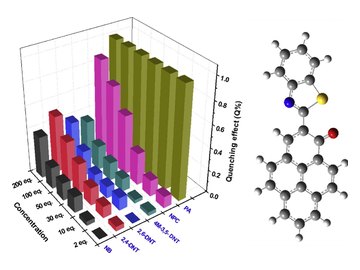
2-(벤조싸이아졸-2-일)피렌-1-올(P3-NS)을 나이트로방향족 화합물(NAC)을 위한 들뜬상태 분자내 양성자 전이(ESIPT) 기반 센서로 개발하였다. 광물리적·광학적 물성 연구 결과, P3-NS는 벤조싸이아졸과 피렌-1-올 고리를 연결하는 C-C 결합 주위의 회전과 피렌-OH 양성자의 위치에서 비롯된 다양한 용매 의존적 이성질체 형태로 존재한다. 밀도범함수이론(DFT) 계산을 통해 서로 다른 용매에 녹은 P3-NS의 주요 구조를 규명할 수 있었다. 비극성 또는 약극성 용매에서 전자가 들뜨면 P3-NS는 ESIPT 반응을 일으켜 약하게만 형광을 내는 생성물을 형성한다. 반면 강극성 용매에서는 P3-NS가 강한 형광을 내는 탈양성자화 형태로 존재한다. 시간 의존 DFT 계산 결과, ESIPT 반응으로 생성된 P3-NS 생성물의 형광 소광은 S1과 T2 상태 사이의 원뿔형 교차점(conical intersection)에서 일어나는 계간 전이(intersystem crossing)에 의한 것으로 나타났다. 강극성 용매에 존재하는 P3-NS의 음이온 형태는 나이트로방향족 화합물(NAC)에 대한 형광 센서임이 밝혀졌다. NAC에 의한 형광 소광은 P3-NS 음이온 형태의 양성자화(정적 소광)와 음이온 형태에서 NAC로의 광유도 전자 전이(동적 소광)에 의해 일어난다.
Original abstract (English)
2-(Benzothiazol-2-yl)pyren-1-ol (P3-NS) was developed as an excited-state intramolecular proton transfer (ESIPT)-based sensor for nitroaromatic compounds (NACs). Results of studies of its photophysical and optical properties show that P3-NS exists in various, solvent-dependent isomeric forms arising from rotation about the C-C bond connecting the benzothiazole and pyren-1-ol rings and the location of the pyrene-OH proton. The results of density functional theory (DFT) calculations enabled identification of the major structures of P3-NS dissolved in different solvents. Upon electronic excitation in nonpolar or weakly polar solvents, P3-NS undergoes an ESIPT reaction to form a product that only weakly fluoresces. In contrast, P3-NS exists in a strongly fluorescent deprotonated form in highly polar solvents. The results of time-dependent DFT calculations indicate that fluorescence quenching of the product generated by the ESIPT reaction of P3-NS is caused by intersystem crossing at a conical intersection between the S1 and T2 states. The anionic form of P3-NS, present in highly polar solvents, was shown to be a fluorescence sensor for nitroaromatic compounds (NACs). Fluorescence quenching by NACs occurs by protonation of the anionic form of P3-NS (static quenching) and by photoinduced electron transfer from the anionic form to NACs (dynamic quenching).