


Synthesis, Structure, and Photoluminescence Properties of a Metal-Organic Framework with Hexagonal Channels: Selective Turn-On Sensing for Mg2+ Ion

초록
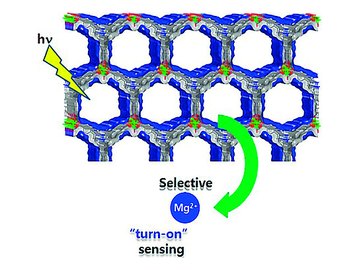
질소 주개 원자를 갖는 삼발이형 트라이카복실레이트 리간드를 바탕으로 넓은 1차원 육방 채널을 갖는 3차원 Cd2+ 골격(1)을 제조하였다. Cd 원자는 카복실레이트와 아쿠아 리간드로 가교된 사슬 구조를 이룬다. Mg2+ 이온을 포획하면 이 다공성 물질의 형광 방출이 Mg2+가 없을 때보다 5.2배 커졌다. 우리가 아는 한, 이러한 증대는 금속-유기 골격체 감지 시스템에서 이전에 보고된 바 없다. 1의 감지 성능은 Mg2+의 포함과 방출을 반복하는 주기에 걸쳐 가역적이어서 이 물질의 재사용성을 보여준다. 시험한 다른 금속 이온이 있을 때에도 이 신호가 켜지는(turn-on) 메커니즘의 작동 덕분에 Mg2+ 이온이 선택적으로 검출되었다. 따라서 이 플랫폼은 선택적 Mg2+ 이온 인식을 위한 유망한 센서 물질이다.
Original abstract (English)
A three-dimensional Cd2+ framework (1) with wide one-dimensional hexagonal channels was prepared based on a tripodal tricarboxylate ligand possessing nitrogen donor atoms. The Cd atoms form a chain structure bridged by carboxylates and aqua ligands. Upon Mg2+ ion capture, the fluorescence emission of this porous material was 5.2 times greater than its Mg2+-free fluorescence. To the best of our knowledge, such enhancement has not been previously reported for metal-organic framework sensory systems. The sensing performance of 1 is reversible over repeated cycles of Mg2+ inclusion and release, revealing the reusability of this material. In the presence of other tested metal ions, Mg2+ ions were selectively detected owing to the operation of this turn-on mechanism. Thus, this platform is a promising sensor material for selective Mg2+ ion recognition.