


Elucidating the Role of Molecule-Electrode Interfacial Defects in Charge Tunneling Characteristics of Large-area Junctions

초록
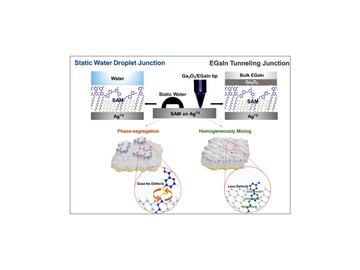
유기-무기 접촉부의 계면 화학은 다양한 분자 및 유기 전자소자와 그 밖의 시스템의 기능을 결정적으로 좌우한다. 그러나 분자 수준에서 계면 구조에 접근할 수 있는 손쉬운 작동 중(in-operando) 분광 기법이 부족하여 이 화학을 이해하기는 어렵다. 여기서 우리는 동일한 유기 박막과 서로 다른 액체 상부 접촉(물방울 대 갈륨-인듐 공융 합금)으로 형성한 두 유사 접합을 비교하여 난해한 계면 특성을 규명한다. 구체적으로, 혼합 자기조립 단분자막(SAM)을 이용하여 유기 표면의 표면 형상을 미세 조정하였다. 즉, 정류기(2,2'-바이피리딜 말단 n-운데케인싸이올레이트, SC11BIPY로 표기)로 구성된 단일 성분 SAM을 서로 다른 길이의 비정류성 n-알케인싸이올레이트(SCn, n = 8, 10, 12, 14, 16, 18로 표기)로 체계적으로 희석하였다. 이렇게 얻은 혼합 SAM의 젖음성과, 두 가지 액체 상부 접촉에서의 터널링 전류를 분석함으로써 SAM//액체 계면에서 상분리와 가우슈(gauche) 결함의 역할을 조사할 수 있다. 본 연구 결과는 SC11BIPY와 SCn 사이의 길이 차이가 표면의 나노 규모 구덩이와 가우슈 형태 결함으로 이어지며, 접촉력의 차이(정수압 대 사용자 압력)와 그에 따른 접촉의 정합성이 젖음성과 정류 거동의 차이를 설명함을 보여준다. 우리의 연구는 분자 규모 전자소자의 성능에서 분자-전극 계면 결함이 하는 역할에 대한 통찰을 제공한다.
Original abstract (English)
Interfacial chemistry at organic-inorganic contact critically determines the function of a wide range of molecular and organic electronic devices and other systems. The chemistry is, however, difficult to understand due to the lack of easily accessible in-operando spectroscopic techniques that permit access to interfacial structure on a molecular scale. Herein, we compare two analogous junctions formed with identical organic thin films and different liquid top-contacts (water droplet vs eutectic gallium indium alloy) and elucidate the puzzling interfacial characteristics. Specifically, we fine-tune the surface topography of the organic surface using mixed self-assembled monolayers (SAMs): a single-component SAM composed of rectifier (2,2'-bipyridyl-terminated n-undecanethiolate, denoted as SC11BIPY) is systematically diluted with nonrectifying n-alkanethiolates of different lengths (denoted as SCn, where n = 8, 10, 12, 14, 16, 18). Characterization of the resulting mixed SAMs in wettability and tunneling currents with the two separate liquid top-contacts allows us to investigate the role of phase segregation and gauche defects in the SAM//liquid interfaces. The results reported here show that the difference in length between SC11BIPY and SCn is translated into nanoscopic pits and gauche-conformer defects on the surface, and the difference in contact force (hydrostatic vs user pressures), and hence conformity of contact, accounts for the difference in wettability and rectification behaviors. Our work provides an insight into the role of molecule-electrode interfacial defects in the performance of molecular-scale electronic devices.